



Looking to save time and money with DevOps practices and services like agility, automation, continuity, and governance? Turn to IRDevOps to implement DevOps best practices, including integration with cloud, continuous integration and continuous delivery (CI/CD), GitOps, containerization, DevSecOps, AI/ML, and AI Ops, as well as a host of other services. Automate and coordinate software development life cycle (SDLC) processes like development, security, testing, deployment with IRDevOps, a DevOps solutions provider.
DevOps Maturity Model
We at IRDevOps have a vision of DevOps approach in the following maturity model. It was designed to help companies assess their current vs desired state of

Manual

Initial

Mature

Advanced

SRE
Pain points
- Any deployment requires active and extensive participation of developers
- Credentials to production instances are not managed securely
- Deployment process is manual, undefіned, not repeatable, and fails frequently
- No health checking, all troubleshooting purely reactive
- Poor communication between Dev and Ops teams
Key milestones
- Deployment process is defined and repeatable on developer workstations
- Routine deployment tasks are automated
- Faster deployment process
- Manual health checks via API / tools and modified process
- Consolidated logging
Challenges and pitfalls
- Deployment process is still unstable
- Deployment scripts feature custom dependencies
Remaining pain points
- Deployment still slow
- Deployment requires specific skills and knowledge
- Logs are difficult to access / analyze
Key milestones
- Entire flow (build, package, deployment) is automated
- Any dev team member can run deployment
- Health check scripts integrated with CI (still triggered manually)
- Standardized logs complete with monitoring
Challenges and pitfalls
- No deployment traceability
- Deployment process enabled by a collection of tools with no UI
Remaining pain points
- Manual rollbacks only
- Scaling is still semi-manual, requires proactive manual intervention (can’t scale automatically in response to load)
- Monitoring can’t recognize patterns and predict issues
Key milestones
- Any team member has the capability to deploy to any environment
- Permission-based model that restricts deployment
- Completely automated health checks
- Centralized monitoring helps automatically diagnose 99% of issues
- Automatic documenting
Challenges
- Costly to implement
- Requires high level of skill to maintain and evolve in the long run
Key milestones
- Continuous improvement of reliability.
- Translating measurable indicators and metrics to business and decision making level
- Continuous enhanced monitoring and troubleshooting algorithms
Challenges
- Skills and culture
- Costly to implement continuous improvement process
IRDevOps DevOps experts will conduct a comprehensive assessment of your company’s infrastructure and DevOps processes to determine its current maturity level, then advise on areas of improvement and strategic steps for advancing it.
IRDevOps DevOps Services and Cloud Expertise
IRDevOps provides DevOps as a (managed) service, monitoring projects from start to finish across a variety of industries. We are working in Finance, Travel, Transportation & Hospitality, Healthcare & Life Sciences, Media & Entertainment, Retail & Distribution among other industries.
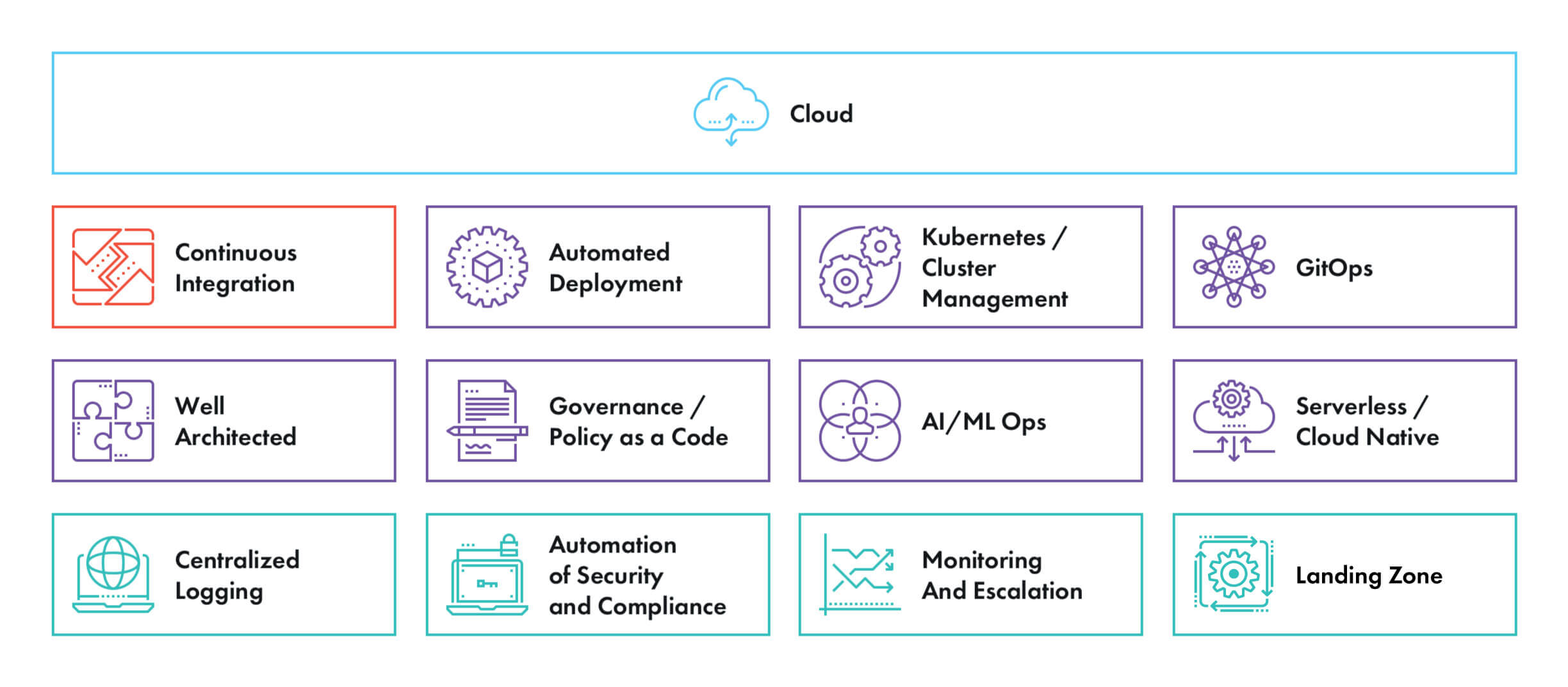
IRDevOps DevOps Solutions and Services
As a part of its DevOps consulting on continuous integration and continuous delivery, IRDevOps helps clients maintain strict control throughout the SDLC by automating product tests, deployment, and code management.
Targets of CI/CD DevOps Services:
- Shorten release lifecycle
- Shorten mean time to repair
- Ensure effortless deployment.
Approaches to Accomplishing CI/CD DevOps Services:
- Build config as a code
- Employ disposable, ephemeral agents
- Prevent downtime during releases
- Separate CI and CD
- Manage artifacts.
Frameworks and Tools for CI/CD DevOps Services:
- Scalable CI
- Seamless decomposition and parallel running
- Automatic code review and reporting
- Cloud-agnostic tools (including Jenkins, Bamboo, TeamCity, TravisCI, Concourse, GitLab CI, and Bitbucket Pipelines)
- Cloud-native tools (including AWS CodePipeline, Google Cloud Build, and Azure DevOps).
As a DevOps services company, IRDevOps integrates automated testing into the product / infrastructure and development processes. This ensures quick report times for inconsistencies, 24/7 uptime, and cost savings. It can also speed up your company’s release cycles.
Automated Testing Targets:
- Perform automated release checks
- Provide consistent and reliable feedback
- Ensure increased checks frequency.
Approaches to Accomplishing Automated Testing:
- Unit, Integration, Functional
- Web, API, mobile, and microservices
- TDD, BDD, and DDT
- Smoke and regression testing
- Benchmark testing, HA testing, and performance testing
- Parallel, scalable testing.
Frameworks and tools for CI/CD DevOps Services:
- Automation adoption and process changes
- JMeter, Artillery, Tsung, and Gatling
- Selenium, Appium, Saucelab, and Browserstack
- Test Complete and QTP.
Infrastructure management involves automatic environment provisioning, a monitoring program that sends relevant alerts, and autoscaling. This process is essential for product success.
As a DevOps consulting services provider, IRDevOps can help you maintain a healthy workflow and eliminate many critical problems at the source with the help of monitoring and alerting tools.
Infrastructure Management Targets:
- Ensure environment consistency
- Provide testability
- Shorten SDLC.
Approaches to Infrastructure Management:
- Infrastructure as a code
- Alerting & Monitoring
- Capacity Planning.
Infrastructure Management Tools, Frameworks and Technologies:
- Terraform, CloudFormation, ARM Templates, and GCP Deployment Manager
- AWS ECS, EKS, Fargate; GCP GKE; Azure AKS, and Nomad
- Docker, Puppet, Chef, and Ansible
- Prometheus, ELK, Grafana, Zabbix, DataDog, Splunk, and Fluentd
- AppsDynamics, and NewRelic
- AutoScaling and Blue/Green deployments.
As a DevOps solutions and services provider, IRDevOps concentrates on building security into the product at the earliest stages of the SDLC, instead of slotting it in at the final stage. This approach is called DevSecOps, and it can lead to seamless process integration, better security and compliance, and lower costs.
Security Management Targets:
- Identify vulnerabilities
- Ensure continuous compliance
- Apply security-first approach.
Approaches to Security Management:
- DevSecOps
- Policy as a Code
- Static Application Security Testing (SAST)
- Dynamic Application Security Testing (DAST)
- Software Composition Analysis (SCA)
- Cloud Compliance Monitoring
- Infrastructure and Container Scanning.
Security Management Tools, Frameworks, and Technologies:
- Checkmarx, SonarQube, and Veracode
- Burp Suite, Nessus, and Qualys
- Snyk and Sonatype Nexus
- Cloud-native tools, Scout Suite, Prowler, Azucar, and kubeaudit
- Gitlab Security Center.
IRDevOps has strong experience working in Cloud. When IRDevOps’s software development and operations teams work on a Cloud project, we always follow best practices by identifying measurable operational goals, infrastructure management, and solution design patterns.
As a DevOps services provider, IRDevOps is familiar with cloud-integrated DevOps tools and respective offerings for DevOps automation from major cloud providers.
Cloud Targets:
- Go global in minutes
- Reduce costs of management
- Improve security and compliance.
In addition to its vast expertise as a DevOps Consult, IRDevOps operations teams have hands-on knowledge and experience working with production workloads in Docker and Kubernetes since several years old.
Docker
- Best practices
- Technologies and tools
- Docker in dev, testing, production workloads.
Kubernetes
- K8S competency center
- Technologies and tools
- Operations
- CI/CD
Docker & Kubernetes Targets:
- Ensure deployments flexibility by design
- Guarantee hybrid or multi-cloud agility
- Provide efficient resources management.
Kubernetes
K8S Provisioning:
- EKS, AKS, GKE
- Kops, Rancher, OpenShift, and Konvoy
- K8S on Mesos
- OnPrem/Bare metal.
Operations and Management
- Helm
- Istio and Calico
- Portworx
- Styra
- Traefik
- Prometheus, ELK, and Grafana
- Kubefed
- Kudo/Operators
- Kubeless
DevOps as a Service: Pipeline
A DevOps pipeline is a sequence of workflow tasks. It consists of several different stages. Configuring each stage as a part of DevOps as a Service contributes to a smooth and effective delivery through SDLC.
1. Build Automation and Continuous Integration
New features implemented by developers are integrated into the central code base on a continuous basis, built and unit tested
2. Test Automation
New versions of applications are continuously tested to ensure new features operate correctly and don't break existing functionality. Types of tests include: integration tests; UI tests; performance tests
3. Deployment Automation
Deployment of new versions is automated (minimizing manual steps and human intervention), allowing for reliable delivery of new functionality to target environments in the shortest time possible
4. Platform Provisioning and Configuration Management
Enables creation, maintenance and tear down of complete environments automatically or at the push of a button. Ensures correct configuration and repeatability of environments; facilitates horizontal scalability and sandboxing
5. Monitoring / APM / Observability
Gathering, storage, and analysis of data reflecting vital parameters and behavior of applicants and infrastructure
Why Choose IRDevOps as DevOps Service Provider?
Turn to IRDevOps for a comprehensive DevOps framework that will help you to:
- reduce and control costs in a more effective way, while focusing on core business, seizing new opportunities and innovating
- create a DevOps assessment roadmap that improves software release and delivery processes, speeds up time to market and decreases technical debt
- standardize and industrialize business processes by adapting to changes quickly, boosting analytical capabilities and ensuring regulatory compliance